Sitting Less When Your Job Makes You Sit
Desk days are long. Here are gentle, realistic ways to break them up without hurting your productivity or your pride.
Why long sitting feels the way it does
If you've ever stood up after a long stretch at your desk and felt stiff, a little foggy, or oddly tired, you're not imagining it. Staying in one position for a long time means your muscles do very little work, and your joints stay in the same angle for hours. Many people notice tight hips, a achy lower back, or tension in the neck and shoulders by late afternoon.
Sitting also tends to go hand in hand with deep focus. You look up and two hours have passed. That's not a personal failing. Desk work is built to pull your attention in, and your body simply isn't part of the picture while you concentrate.
The good news is that you don't need a big overhaul. Small, repeated breaks from sitting fit better into a workday than one ambitious plan you can't keep up. The goal is to change position often, not to be perfect.
Tying movement to things that already happen
Reminders and willpower work for a while, then fade. A more dependable approach is to attach movement to moments that already happen in your day, so you don't have to remember anything.
Here are a few ideas to try:
- Stand up whenever you finish a task or send a big email.
- Refill your water glass at a spot farther from your desk, rather than keeping a bottle within reach.
- Stand while you wait for a file to load, a meeting to start, or the coffee to brew.
- Take the long way to the restroom or printer.
- Walk over to talk to a coworker instead of sending a message, when that makes sense.
- Stand up and stretch each time you switch from one project to another.
You might also pick one regular anchor, such as the top of each hour, and make it your cue. Even a minute or two on your feet counts as a change of position, and that's the whole point.
Phone calls as walking time
Calls are one of the easiest places to sneak in movement, because you often don't need to look at a screen. If your job allows it, try taking calls on your feet.
Using a headset or earbuds frees your hands and lets you pace around a room, walk down a hallway, or step outside for some fresh air. If you're on a call where you mostly listen, walking slowly can feel natural. For calls where you need to take notes or share a screen, you might simply stand at a counter or a raised surface for the duration.
A few things help this feel comfortable:
- Choose calls that don't need your computer, and start with those.
- Wear shoes that are comfortable for walking, or keep a pair at work.
- Walk at an easy pace where you can still talk without effort.
- Watch your footing, especially on stairs or in busy areas, so your attention stays safe.
If you work in a shared space where walking and talking would be disruptive, a quiet corridor, stairwell, or outdoor spot might work. If none of that is practical, standing at your desk during the call is still a useful change.
Simple stretches that fit in a hallway
You don't need a mat or special clothes to loosen up. A short hallway, or even the space beside your chair, is enough. Move gently, breathe normally, and stop if anything feels sharp or painful. Stretching should feel like mild tension, never pain.
Here are a few easy options:
- Shoulder rolls: Lift your shoulders toward your ears, roll them back and down, and repeat several times. This can ease the hunched feeling that builds up at a keyboard.
- Standing chest opener: Clasp your hands behind your back, or hold a doorframe at shoulder height, and gently lean forward to open the front of your chest.
- Hip flexor stretch: Step one foot back into a shallow lunge, keep your torso upright, and feel a gentle stretch at the front of your back hip. Switch sides.
- Calf stretch: Place your hands on a wall, step one foot back with the heel down, and lean in slightly.
- Gentle neck tilt: Drop one ear toward your shoulder, pause, then switch. Keep your shoulders relaxed.
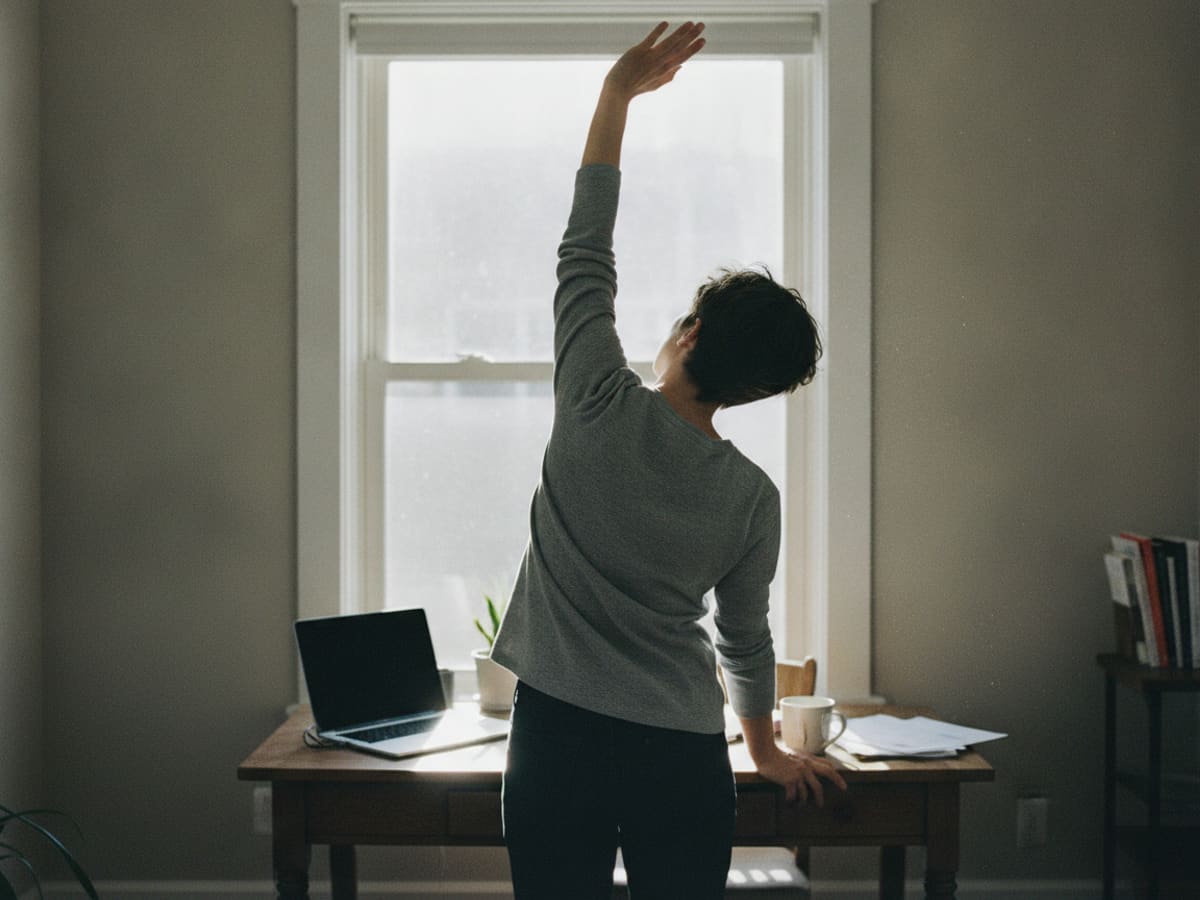
- Standing side reach: Raise one arm overhead and lean gently to the opposite side.
You can mix and match these. Two or three stretches done a few times a day often feel better than a long session you skip.
Walking a lap around the floor, going up a flight of stairs, or simply standing and shifting your weight also helps. Variety matters more than any single move.
If you have pain or a condition, who to ask
Most people can try the ideas above comfortably, but your situation may be different. If you have ongoing back, neck, hip, or joint pain, a past injury, balance concerns, are pregnant, or live with a health condition that affects how you move, it makes sense to get personal guidance first.
A doctor can tell you whether a particular kind of movement is a good fit for you. A physical therapist can look at how you sit, stand, and move, and suggest stretches and habits suited to your body. If your workspace seems to be part of the problem, some workplaces also offer ergonomic assessments, which you can ask your employer or human resources team about.
Moving more at a desk job comes down to small, repeatable choices. Start with one or two that feel easy, and let them become part of your routine.